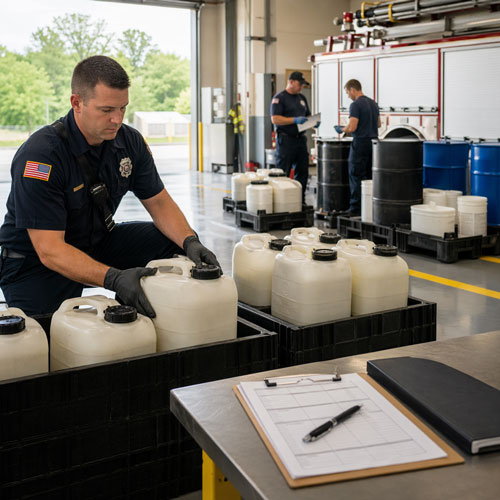
How New Jersey’s AFFF collection and destruction program affects fire departments under the DEP and DCA
The New Jersey Department of Environmental Protection and the New Jersey Department of Community Affairs are running a statewide effort to collect and safely destroy PFAS-containing firefighting foams, including aqueous film-forming foam, or AFFF. According to the March 20, 2026 announcement from the Sherrill Administration, the program is helping hundreds of fire departments across New Jersey remove these foams without paying disposal costs themselves.
For fire departments, that changes the practical side of compliance. Instead of arranging private disposal on their own, departments have a state-backed path to turn in inventory through regional collection events. The state described the effort as one of the largest cooperative collection programs of its kind in the nation, funded through a $16.6 million appropriation.
The direct effect is straightforward:
- Departments have a no-cost route to remove PFAS-containing foam stock.
- Departments need to identify and separate affected foam inventory.
- Departments need to plan for replacement agents and equipment cleaning.
- Departments need to follow New Jersey’s tighter limits on when AFFF can be used before the full ban takes effect.
The state is framing the program as both a compliance tool and a pollution-prevention step. DEP Acting Commissioner Ed Potosnak said the goal is to keep PFAS out of the environment and avoid future cleanup costs. For local departments, that means the program is not only about getting rid of old product. It is also about reducing the risk of accidental releases, training discharges, and contamination of new fluorine-free foam supplies.
State ban deadlines for PFAS-containing foam use and storage in New Jersey
New Jersey adopted state law in 2024 directing the DEP to establish a collection and disposal program for PFAS-containing firefighting foams. The state also changed the compliance timeline for most use restrictions. The updated New Jersey guidance says the law was amended to move most-use compliance to January 1, 2027.
That date matters because departments still holding PFAS-containing AFFF need to use the remaining time to remove inventory, review apparatus and fixed systems, and prepare replacement plans. The March 20, 2026 state announcement says the collection program is helping departments comply with state legislation that bans the use and storage of these foams after January 1, 2027.
For department leaders, the deadline creates two separate planning tracks:
- Short-term control of existing foam. Limit use under the updated state guidance, stop any training use, and prevent avoidable discharges.
- Full transition before January 1, 2027. Remove stock, clean equipment, and prepare for fluorine-free replacement where needed.
If your department has not completed an inventory, the deadline is close enough that inventory control should be treated as an active operational task, not a future project.
Program logistics: regional collection sites, no-cost disposal, and contractor destruction in Hunterdon County and beyond
New Jersey’s collection program uses two regional sites to receive PFAS-containing firefighting foams. The March 20, 2026 announcement says those sites collected foam throughout the month for destruction by an out-of-state contractor. One of the collection events highlighted by the state took place at the northern regional site in Hunterdon County.
The practical takeaway for fire departments is that the state has already set up the disposal chain:
- Regional collection points receive the foam.
- The program is offered at no cost to participating fire departments.
- An out-of-state contractor handles destruction.
That structure removes one of the biggest barriers departments face with PFAS foam disposal: finding a lawful, affordable destruction option. The state announcement does not ask departments to negotiate separate destruction arrangements under this program. Instead, the state-led process centralizes collection and disposal.
Departments should still expect internal preparation work before drop-off. That includes confirming what products are in storage, identifying container sizes and quantities, and coordinating transport and chain-of-custody steps required by the collection program. The state announcement does not list every handling detail, so departments should use the New Jersey Department of Community Affairs guidance and any program instructions tied to the collection event they attend.
| Program element | What New Jersey says | What a fire department should do |
|---|---|---|
| Collection sites | Two regional sites are receiving foam | Confirm which site serves your department and prepare inventory for delivery |
| Cost | No cost to fire departments | Use the state program instead of delaying disposal over budget concerns |
| Destruction | Foam is destroyed by an out-of-state contractor | Document what was turned in and keep disposal records |
| Program purpose | Help departments comply with New Jersey law | Link disposal planning to your January 1, 2027 compliance schedule |
Operational restrictions on AFFF use, training bans, and discharge notification under New Jersey guidance
The updated New Jersey memo gives fire departments clear operating limits for PFAS-containing AFFF before the full compliance deadline. It says PFAS-containing AFFF should never be used for training, should be limited to true Class B emergencies, and requires notification if discharged.
Those three points have immediate operational consequences.
First, training use is off the table. Departments should remove PFAS-containing AFFF from any drill, demonstration, testing, or familiarization activity. If a training plan still references legacy foam, that plan needs revision.
Second, use is restricted to true Class B emergencies. That means departments should not treat AFFF as a routine suppression option where another compliant agent or tactic is available. The state guidance narrows use to actual emergency incidents involving the kind of flammable liquid fire AFFF was designed to address.
Third, discharge triggers notification duties. The updated memo says notification is required if PFAS-containing AFFF is discharged. Departments should make sure incident command staff, safety officers, and reporting personnel know that a release is not just an operational event. It is also a reportable event under state guidance.
These restrictions matter even for departments planning to surrender all remaining stock soon. Until the foam is removed, the department still needs controls on storage, access, training materials, and incident reporting.
A simple internal control plan should include:
- Mark all PFAS-containing AFFF inventory clearly.
- Restrict access to authorized personnel.
- Remove the foam from training documents and lesson plans.
- Brief officers that use is limited to true Class B emergencies.
- Set a written reporting step for any discharge.
Decontamination requirements before switching to fluorine-free foam under New Jersey fire equipment guidance
New Jersey’s updated guidance stresses that decontamination is necessary before switching from PFAS-containing AFFF to fluorine-free foam. The reason is direct: residue left in tanks, lines, proportioning equipment, nozzles, and related components can contaminate the replacement foam and create new releases.
The state’s decontamination guidance is not a side issue. It is part of the transition itself. A department that simply empties old foam and pours in fluorine-free product risks carrying PFAS residue into the new system. That undermines the point of the switch and creates a fresh contamination problem inside apparatus or equipment that was supposed to be cleaned.
For fire departments, decontamination planning should cover:
- Apparatus foam tanks
- Hose lines and plumbing
- Proportioning systems
- Nozzles and discharge devices
- Portable equipment and any storage or transfer containers that held PFAS-containing foam
The New Jersey Department of Community Affairs published specific fire equipment decontamination guidance on January 20, 2026. Departments should use that document as the working standard for cleaning steps, verification, and sequencing before introducing fluorine-free foam.
In practice, this means replacement planning has two parts, not one:
- Remove and dispose of PFAS-containing foam through the state program.
- Decontaminate equipment before loading replacement fluorine-free foam.
If your department skips the second step, the transition is incomplete.
Fire department compliance checklist for inventory removal and replacement planning in New Jersey
Use this checklist to organize the work before the January 1, 2027 New Jersey deadline.
- Identify all PFAS-containing foam stock.
Check apparatus, stations, training caches, fixed systems, trailers, and mutual-aid storage locations. - Record product details.
List product name, container size, quantity, storage location, and whether the foam is in sealed containers or loaded in equipment. - Stop all training use.
Update training plans so PFAS-containing AFFF is never used for drills or demonstrations. - Restrict emergency use.
Brief command staff that the updated New Jersey memo limits use to true Class B emergencies. - Set a discharge notification procedure.
Make sure officers know who must be notified if PFAS-containing AFFF is discharged. - Register or coordinate for collection.
Use the New Jersey program instructions for the appropriate regional collection site. - Prepare transport and turnover records.
Keep internal records showing what inventory left the department and when. - Review replacement needs.
Determine where fluorine-free foam is needed after PFAS-containing stock is removed. - Follow New Jersey decontamination guidance.
Clean tanks, lines, proportioners, nozzles, and related equipment before introducing replacement foam. - Keep compliance files.
Save inventory lists, disposal records, decontamination records, updated SOPs, and any state communications.
This checklist is useful for career departments, volunteer departments, airport units, and any local agency that still has legacy Class B foam in storage or equipment.
Next steps for New Jersey fire departments before January 1, 2027
If your department still has PFAS-containing AFFF, the next move is to treat removal and transition planning as an active compliance project. Start with a full inventory, confirm whether any foam remains in apparatus or storage, and line up participation in the New Jersey collection program. Then review the January 20, 2026 decontamination guidance so replacement foam is not contaminated by residue left in equipment.
Department leaders should gather these documents now:
- Current foam inventory list
- Apparatus and fixed-system equipment list
- Standard operating procedures for Class B incidents
- Training materials that still mention AFFF
- Incident reporting procedures for foam discharge
- Records from any collection event or disposal transfer
- Decontamination records before loading fluorine-free foam
Questions to settle this month include:
- Where is every PFAS-containing foam container located?
- Is any PFAS-containing foam still loaded in trucks or systems?
- Which regional collection site should the department use?
- Who is responsible for discharge notification?
- What equipment must be decontaminated before replacement foam is added?
- What purchasing steps are needed for fluorine-free foam replacement?
Departments that finish those steps early will be in a stronger position to meet New Jersey’s January 1, 2027 requirements without last-minute operational disruption.
Does New Jersey’s AFFF collection program cost fire departments anything?
No. The March 20, 2026 announcement says the DEP and DCA program collects and destroys PFAS-containing firefighting foams at no cost to fire departments.
When does New Jersey ban the use and storage of PFAS-containing firefighting foam?
The updated New Jersey guidance says the law was amended to move most-use compliance to January 1, 2027. The state announcement says the legislation bans use and storage after that date.
Can a fire department still use PFAS-containing AFFF before January 1, 2027?
New Jersey’s updated memo says PFAS-containing AFFF should never be used for training and should be limited to true Class B emergencies. If it is discharged, notification is required.
Why does equipment need decontamination before switching to fluorine-free foam?
New Jersey’s guidance says decontamination is needed to avoid contaminating replacement fluorine-free foam and causing new PFAS releases from residue left in equipment.
Where does New Jersey collect the foam for disposal?
The state says two regional sites have been collecting PFAS-containing firefighting foams, including a northern regional site in Hunterdon County, with destruction handled by an out-of-state contractor.
Sources
- Sherrill Administration Highlights Success of Historic Program Helping Hundreds of Fire Departments Remove PFAS-Containing Firefighting Foams
- Updated Guidance on the Use of Class B Aqueous Film Forming Foam (AFFF)
- Class B Foam with PFAS: Fire Equipment Decontamination Guidance
Last updated
April 21, 2026